Cobra Snakes’ Spotted Lurking In Tree, But If You Look Closer You’ll Realize The Scary Truth
Ruth KamauFeb 5, 2025
In the wild realm of insects, the Atlas moth stands out not only for its stunning beauty but also for its remarkable intelligence when it comes to survival. This unique creature has evolved to possess wings that closely resemble the head of a venomous snake, a clever disguise that proves beneficial when facing threats.
The Atlas moth, boasting mesmerizing patterns and markings, has wing tips that bear an uncanny resemblance to the curved shape of a cobra’s head. Its defense mechanisms don’t stop there; when faced with danger, the moth drops to the ground and fans its expansive wings in a motion that strikingly mimics a snake’s head and neck.
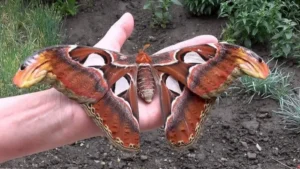
A person holding the Atlas moth with its wings fully stretched, Photo Credit: Rob/Twitter
This intriguing resemblance is so remarkable that in China, the moth is fittingly known as the “snake’s head moth” in Cantonese. A recent photograph captured by UK wildlife photographer Brian Bevan showcased the moth resting gracefully on a leaf’s tip. Native to the tropical and subtropical forests of South East Asia, this rare insect is renowned for both its incredible size and distinctive markings, boasting the largest wingspan of any moth on the planet.
The female Atlas moth, in particular, can impressively spread its wings up to 12 inches (30 cm), covering an area of 62 square inches (400 square cm). Mr. Bevan was in awe when he observed the moth up close, noting that the wing tips truly resemble those of a snake’s head and the creature even appeared bird-sized when in flight.
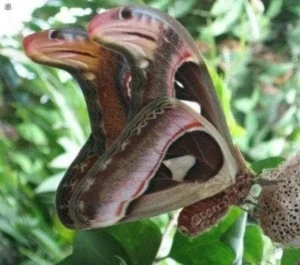
The Atlas moth’s wings in a natural position resembling two snake heads, Photo Credit: Rob/Twitter
The name “Atlas moth” has intriguing origins as well. Some believe the moth earned its name due to the patterns on its wings, which are said to resemble maps. Alternatively, the name is also linked to the Titan Atlas, a figure from Greek mythology condemned to carry the sky on his shoulders. This symbolic burden reflects the moth’s massive wingspan.
Intriguingly, female Atlas moths are significantly larger than males and attract mates by releasing irresistible pheromones from their abdomens. Males, equipped with long, feathery antennae, detect these pheromones to locate their potential partners. Once the moths lay their eggs under leaves, bluish-green caterpillars emerge and begin their feeding frenzy, enjoying Jamaican cherry trees, limes, and citrus fruits as their favorite meals. After a week or two, the caterpillars encase themselves in a silken cocoon, beginning the pupal stage, which lasts about a month.
Opposing Views home
Home
Society
Environment
0:00
/
—
President Trump’s Golf Outing Stuns Internet After People Realize Who He’s Playing Against
Read More
‘Cobra Snakes’ Spotted Lurking In Tree, But If You Look Closer You’ll Realize The Scary Truth
Ruth KamauFeb 5, 2025
In the wild realm of insects, the Atlas moth stands out not only for its stunning beauty but also for its remarkable intelligence when it comes to survival. This unique creature has evolved to possess wings that closely resemble the head of a venomous snake, a clever disguise that proves beneficial when facing threats.
The Atlas moth, boasting mesmerizing patterns and markings, has wing tips that bear an uncanny resemblance to the curved shape of a cobra’s head. Its defense mechanisms don’t stop there; when faced with danger, the moth drops to the ground and fans its expansive wings in a motion that strikingly mimics a snake’s head and neck.
A person holding the Atlas moth with its wings fully stretched, Photo Credit: Rob/Twitter
A person holding the Atlas moth with its wings fully stretched, Photo Credit: Rob/Twitter
This intriguing resemblance is so remarkable that in China, the moth is fittingly known as the “snake’s head moth” in Cantonese. A recent photograph captured by UK wildlife photographer Brian Bevan showcased the moth resting gracefully on a leaf’s tip. Native to the tropical and subtropical forests of South East Asia, this rare insect is renowned for both its incredible size and distinctive markings, boasting the largest wingspan of any moth on the planet.
ADVERTISING
The female Atlas moth, in particular, can impressively spread its wings up to 12 inches (30 cm), covering an area of 62 square inches (400 square cm). Mr. Bevan was in awe when he observed the moth up close, noting that the wing tips truly resemble those of a snake’s head and the creature even appeared bird-sized when in flight.
The Atlas moth’s wings in a natural position resembling two snake heads, Photo Credit: Rob/Twitter
The Atlas moth’s wings in a natural position resembling two snake heads, Photo Credit: Rob/Twitter
The name “Atlas moth” has intriguing origins as well. Some believe the moth earned its name due to the patterns on its wings, which are said to resemble maps. Alternatively, the name is also linked to the Titan Atlas, a figure from Greek mythology condemned to carry the sky on his shoulders. This symbolic burden reflects the moth’s massive wingspan.
Intriguingly, female Atlas moths are significantly larger than males and attract mates by releasing irresistible pheromones from their abdomens. Males, equipped with long, feathery antennae, detect these pheromones to locate their potential partners. Once the moths lay their eggs under leaves, bluish-green caterpillars emerge and begin their feeding frenzy, enjoying Jamaican cherry trees, limes, and citrus fruits as their favorite meals. After a week or two, the caterpillars encase themselves in a silken cocoon, beginning the pupal stage, which lasts about a month.
The Atlas moth with its wings fully stretched,
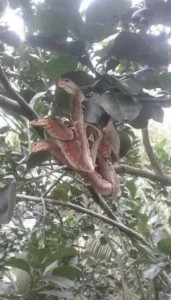
Photo Credit: Patryn/Youtube
The Atlas moth with its wings fully stretched, Photo Credit: Patryn/Youtube
Upon adulthood, male Atlas moths do not possess a mouth and rely on fat reserves accumulated during their caterpillar phase for survival. They quickly mate and soon pass away.
As we marvel at the ingenuity of nature’s mimicry, it is essential to remember the real-life cobras, famous for their threatening hoods. When feeling threatened or agitated, cobras extend their hoods, which consist of skin flaps connected to long ribs, while also hissing loudly to ward off potential predators.
The mesmerizing world of nature’s mimicry continues to astound and inspire, with the Atlas moth showcasing its brilliance in adapting to its surroundings and captivating the world with its remarkable beauty and intelligence.
Sources: Daily Mail